HONEYBOURNE JUNCTION STATION
Grid Reference: SP 115448
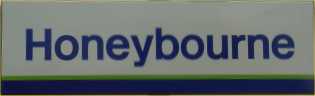
Honeybourne Junction was a large station forming an interchange between the lines from Worcester to Oxford and Stratford to Cheltenham. This was reflected in the station name board that read 'Honeybourne' Junction for Stratford-on-Avon Branch Warwick Leamington Birmingham Broadway Winchcombe and Cheltenham. Honeybourne Junction Station was closed 5th May 1969.
After an extensive campaign by the Cotswold Line Preservation Group a new single platform station was built on the site of the old station. The new station now simply called 'Honeybourne' (see photograph above) opened to passengers on 22nd May 1981, the ceremonial first train being hauled by BR class 47 locomotive No.47510. (Ref: Peter Nicholson, Railways of the Cotswolds, 1981.)
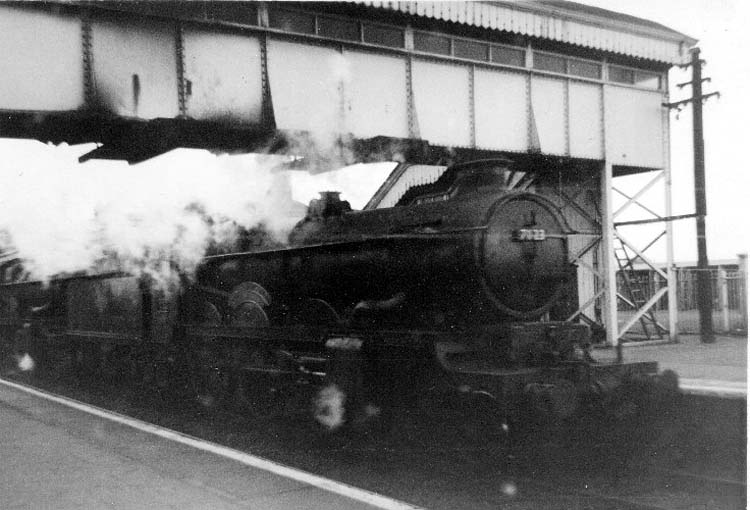
This interesting photograph was taken on 11th April 1964 by Derek Parsons and show two of Worcester's 'Castle' Class locomotives heading towards Worcester, presumably after having deputised for diesels in express passenger trains to Paddington. At the front is No.7023 'Penrice Castle' and beyond is No.7005 'Sir Edward Elgar'.
A locomotive from Worcester shed was used to bank freight trains up the formidable 1-100 gradient of Chipping Campden bank. This engine which was often a Collett 0-6-0 tender engine, until that class was withdrawn in 1964, also operated local services. Chris Smith, who was the regular fireman at Honeybourne in 1965 advises that the last steam locomotive used at Honeybourne was BR Standard class 4 No.75022 on 30th December 1965. Class 37 diesel locomotive No.D6943 was used at Honeybourne on 31st December and 1st January 1966 after which all steam working over Campden bank ceased. The BR (Western Region) Working Time Table for the period from 14th June 1965 until the end of steam working on 3rd January 1966 shows the following freight trains scheduled for banking from Honeybourne:
|
Headcode |
From/to |
Time off Honeybourne |
Days Run |
Comments |
|
7M35 |
00:10 Rogerstone to Swanbourne |
05:45 |
MX |
Via Cheltenham and run round at Honeybourne |
|
8M64 |
23:10 Neath to Swanbourne |
09:30 |
MX |
Via Cheltenham and run round at Honeybourne |
|
4O12 |
21:20 Heysham Moss to Basingstoke |
11:12 |
MX |
As required |
|
8M64 |
01:30 Neath to Swanbourne |
12:05 |
MO |
Via Cheltenham and run round at Honeybourne |
|
4O14 |
21:40 (SX) Heysham Moss to Basingstoke |
16:57 |
MX |
As required |
|
5E11 |
18:45 Rowley Regis to Ripple Lane |
20:51 |
SO |
|
|
5A02 |
21:55 Worcester to Paddington |
22:53 |
SX |
|
|
6A09 |
23:15 Worcester to Acton |
23:59 |
SX |
In that last summer of steam traction on the Western Region of British Railways one of the main features was steam haulage of many Summer holiday 'extras' from the Midlands to the West Country. These trains were usually worked by one of Oxley's Stanier Class 5 4-6-0's or 'Britannia' 4-6-0's. Oxley received three of this latter class at the start of the summer timetable, Nos. 70045 'Lord Rowallan', No.70047 (unnamed) and No.70053 'Moray Firth'. In 1964 these trains had been the final opportunity to see the rapidly dwindling GWR 'Castle' class locomotives in action, including No. 7011 'Banbury Castle' and No.7023 'Penrice Castle', both transferred from Worcester to Oxley in June 1964.
The summer 1965 Western Region Time Table shows the following trains as scheduled for steam haulage on the Stratford-on-Avon to Cheltenham line:
|
Headcode |
From/to |
Time at Honeybourne |
Comments |
|
1V50 |
21:50 Wolverhampton to Newquay |
23:42 |
9/10th July to 13/14th August |
|
1V51 |
06:35 Wolverhampton to Paignton |
08:11 |
|
|
1V52 |
06:55 Wolverhampton to Penzance |
08:37 |
|
|
1V53 |
08:00 Wolverhampton to Ilfracombe |
09:32 |
|
|
1V54 |
10:05 Wolverhampton to Kingswear |
11:35 |
10th July to 28th August |
|
1M34 |
10:05 Kingswear to Wolverhampton |
15:22 |
From 17th July |
|
1M35 |
11:10 Ilfracombe to Wolverhampton |
16:45 |
From 26th June |
|
1M37 |
11:25 Newquay to Wolverhampton |
18:21 |
10th July to 14th August |
|
1M36 |
14:30 Paignton to Wolverhampton |
19:33 |
|
|
1M39 |
12:20 Penzance to Wolverhampton |
19:48 |
A correspondent to the 'Railway Observer' recorded that the last rostered steam workings on these trains took place on 4th September 1965 when the following trains were noted at Birmingham Snow Hill:
1M34 worked by No.70045 'Lord Rowallan'
1M35 worked by No.70053 'Moray Firth'
1M39 worked by No.7029 'Clun Castle.' (this was by a special request from the Cheltenham branch of the RCTS).
There is no mention of train No.1M36 so one can presume it was worked by a diesel.
The 'Britannia's were then transferred to Banbury shed.
In addition there were two 'extras' on the Worcester to Oxford line that were scheduled for steam haulage to and from Worcester. In practice this train was often worked by diesel to Oxford :
|
Headcode |
From/to |
Time at Honeybourne |
Comments |
|
1O30 |
08:29 Sheffield to Bournemouth |
12:02 |
Changes to steam haulage at Worcester |
|
1E52 |
10:38 Poole to Sheffield |
15:01 |
Changes to 'Peak' diesel haulage at Worcester |
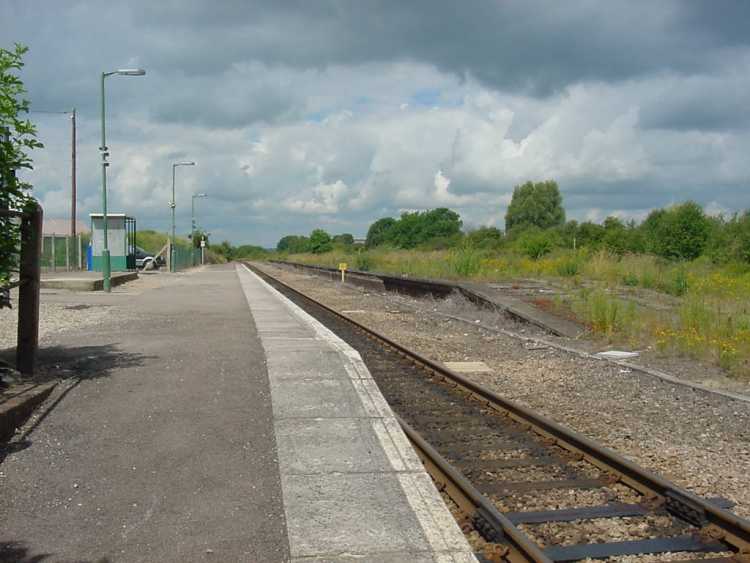
In 2002, the small bus shelter was the only passenger amenity at this once ground station that used to possess four platform faces. The remains of the centre platform can clearly still be seen. Photograph taken by Andrew Smith on 12th July 2002.
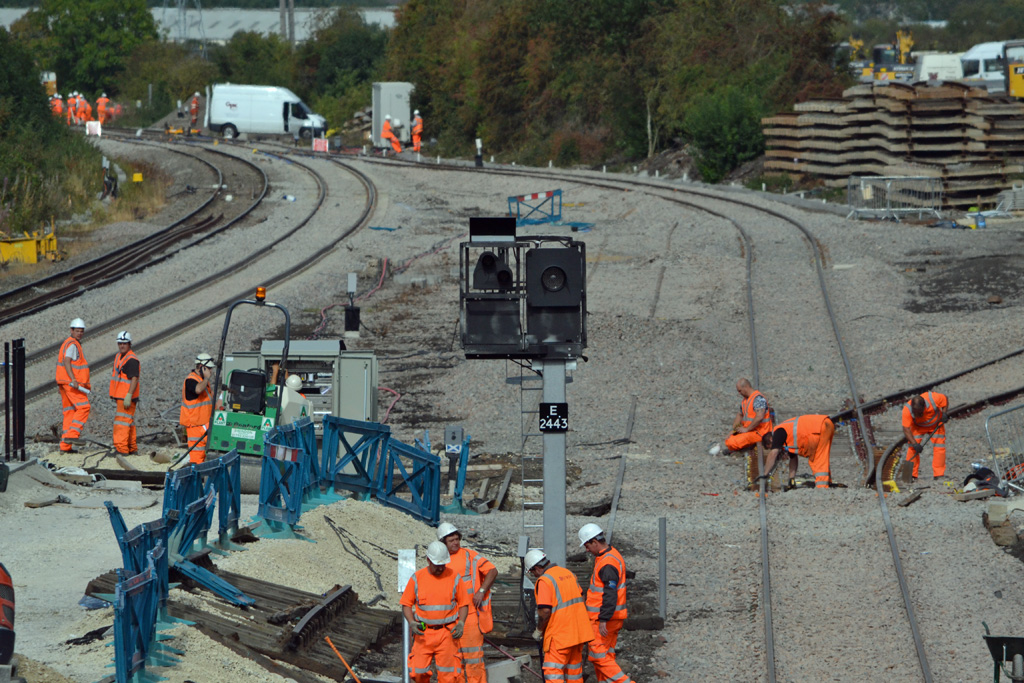
As part of the 2009-2011 plan to reinstate double track on the line, on the weekend of 2nd October 2010 engineers worked through the night to replace a railway bridge in Honeybourne ready for the new track to be laid.
This interesting photograph taken by Andrew Smith on 17th August 2011 shows the view towards Worcester with workers putting the final pieces in place prior to the opening of double track working between Evesham and Moreton-in-Marsh.
Note that the new colour light signal No.E2443 is situated in the middle of the track at 'Platform 3'. On the far right of the photograph is the line to Long Marston and points which lead into sidings.
The complex of lines forming the junction to the east of the station are well illustrated in the following extract from the 1930 edition of the One-inch Ordnance Survey map (sheet 144).
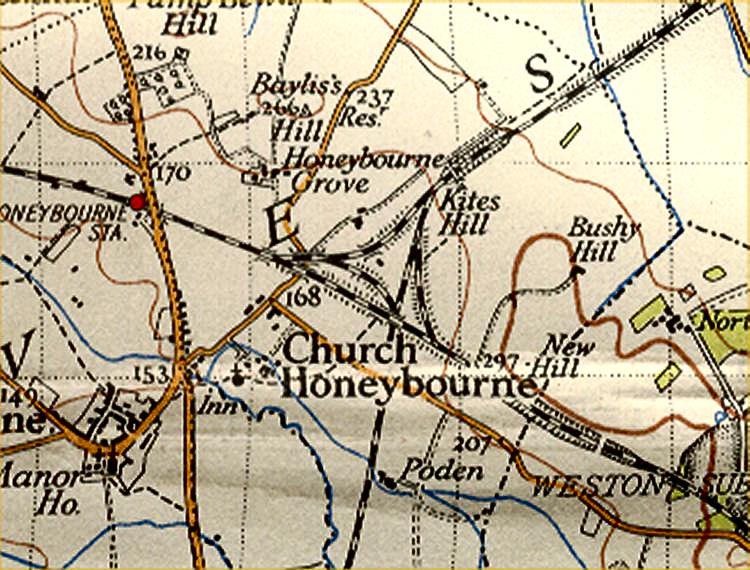
There was a small engine shed at Honeybourne which used engines outbased from Worcester. Douglas Carver recalls that the water supply for locomotives at Honeybourne came from a ditch just outside Chipping Camden tunnel, it acted as a drain for the tunnel then ran for about 400 yards then went underground, and there was a grid over the entrance to the pipe to prevent any rubbish going down the pipe.
The pipe went underground on the down side to a large water tank between Station South Signalbox and the road bridge supplying seven water columns, one on the end of each platform, one on the 'down branch' at North Junction, one on the 'up' loop at The North Junction and one on the 'down' loop at the South Junction, also there was a water column in the garden loop with a parachute tank. He believes water columns were installed at the new sidings at Honeybourne West Loop, but he was transferred to Bristol before they opened.
There was a problem that occurred every autumn leaf fall which was that the grid used to get blocked with leaves and an engine was sent to where the pipe went underground and the Fireman cleared the grid of leaves and any debris from the collecting grid, by then the storage tank was empty, then all locomotives requiring water went to Evesham for water. There was always a queue as all trains arriving at Honeybourne and the bankers required water.
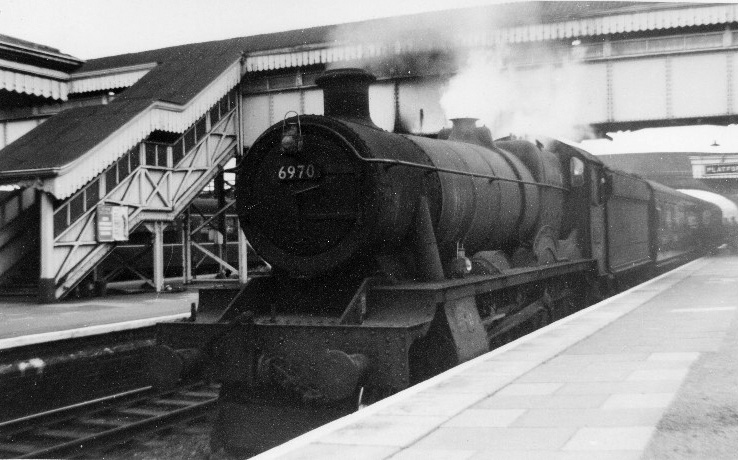
This is ex GWR 4-6-0 'Modified Hall' class No.6970 'Whaddon Hall' of Oxford Shed on 18th May 1963. The locomotive's run down appearance is typical of this era but the locomotive was not withdrawn until June 1964 and was then sent to South Wales for scrap. It is seen arriving at Honeybourne Station on a local train. During World War 2, Whaddon Hall near Milton Keynes in Buckinghamshire was once the location for a secret communications centre housing staff from Bletchley Park. (Photograph by Derek Parsons.)
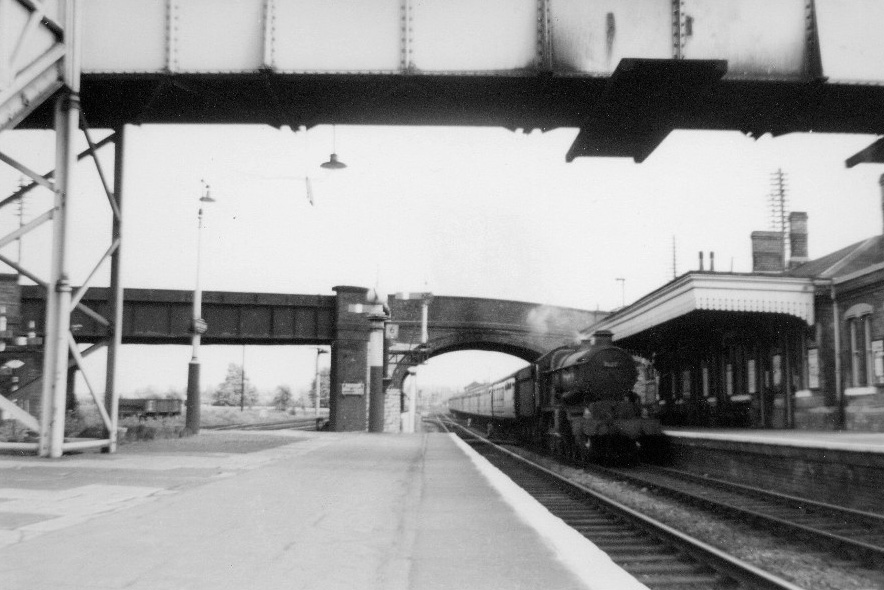
This is the once familiar sight of Worcester based 'Castle' class 4-6-0 No.7027 'Thornbury Castle' arriving at Honeybourne on a down express train. Thornbury Castle is at Thornbury, Gloucestershire and dates back to the 16th century. It is now a hotel. The photograph was taken by Derek Parsons on 11th May 1963.
As part of the 2009-2011 plan to reinstate double track on the line, on the weekend of 2nd October 2010 engineers worked through the night to replace a railway bridge in Honeybourne ready for the new track to be laid.
This is ex GWR 4-6-0 'Modified Hall' class No.6970 'Whaddon Hall' of Oxford Shed on 18th May 1963. The locomotive's run down appearance is typical of this era but the locomotive was not withdrawn until June 1964 and was then sent to South Wales for scrap. It is seen arriving at Honeybourne Station on a local train. During World War 2, Whaddon Hall near Milton Keynes in Buckinghamshire was once the location for a secret communications centre housing staff from Bletchley Park. (Photograph by Derek Parsons.)
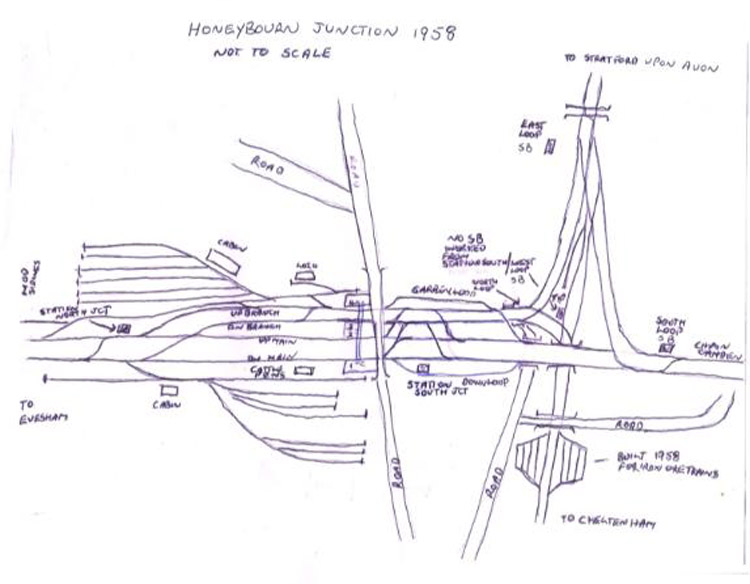
This map is the copyright Doug Carver and reproduced here with permission.
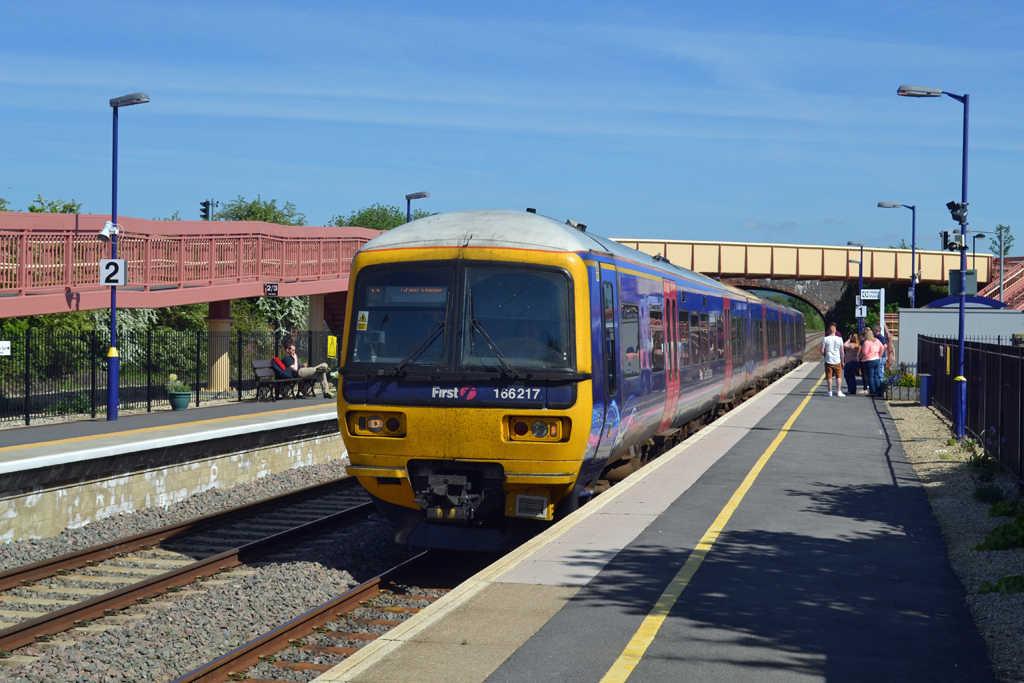
On Saturday 2nd May 2014 class 166 three-car class 166 'Turbo' diesel multiple unit No.166217 pauses briefly at Honeybourne with the 13.21 from London Paddington to Great Malvern (headcode 1W33) service. Photograph taken by Andrew Smith.